This post is part of the series 'Microsoft SQL Server 2016'. Be sure to check out the rest of the blog posts of the series!
Microsoft is adopting a faster release cycle. A few months after the release of SQL Server 2016 in June, SP1 has just been released. This update brings new features and improvements worth covering in detail. In my view, the most important change is the reduction of feature differences between editions.
Until now, Microsoft restricted certain features to the most expensive editions. The Standard Edition was limited in both functionality and hardware resources, and the Express edition even more so.
These restrictions are now largely a thing of the past. All editions can take advantage of nearly all features. Here is a table comparing the feature differences between the 2016 RTM version and 2016 SP1 (source):
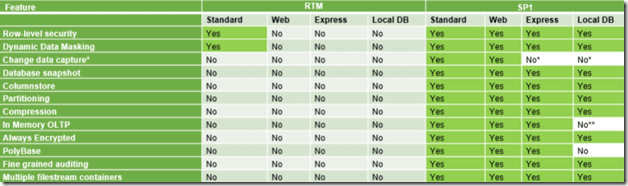
As shown, the Express edition lacks the "Change Data Capture" feature because it requires SQL Agent, which is not available in that edition.
#Why is this important?
First, security features are now available to everyone. Whether you are a small company with limited resources or a large enterprise, you can use the same security mechanisms (Always Encrypted, Dynamic Data Masking, or Row-Level Security). No more excuses for skipping security!
Second, developers can use all available features without worrying about which SQL Server edition will be used at deployment. This saves time during application development and removes the need to purchase a top-tier edition just for a single feature. For software vendors, there is no longer a need to ask customers about their SQL Server edition - simply requiring SQL Server 2016 SP1 or later is enough.
#What differences remain between editions?
In terms of development, features are nearly identical across editions. However, there are still many differences on the operational side.
Of course, resource limitations remain. For example, the Express edition is still limited to 10 GB per database, 4 cores, and 1 GB of RAM. The Standard Edition is limited to 24 cores and 128 GB of RAM.
The Enterprise Edition includes high availability features such as AlwaysOn and Readable Secondaries, advanced BI functionality, more comprehensive audit management, data management tools including Master Data Services (MDS), and more.
You can see a comparative grid on the Microsoft website: https://learn.microsoft.com/en-us/sql/sql-server/editions-and-components-of-sql-server-2016
#Conclusion
This update is a major step forward for Microsoft. Like any update, it brings improvements and new features. More importantly, it allows all developers to use features that were previously reserved for organizations with the budget for premium editions.
Do you have a question or a suggestion about this post? Contact me!
